
Download
3D Flyover
Add to list
More
90.9 km
5 days
97 m
Multi Day
“A windswept ribbon of dikes, orchards, and canal-side towns—flat in profile, big in endurance.”
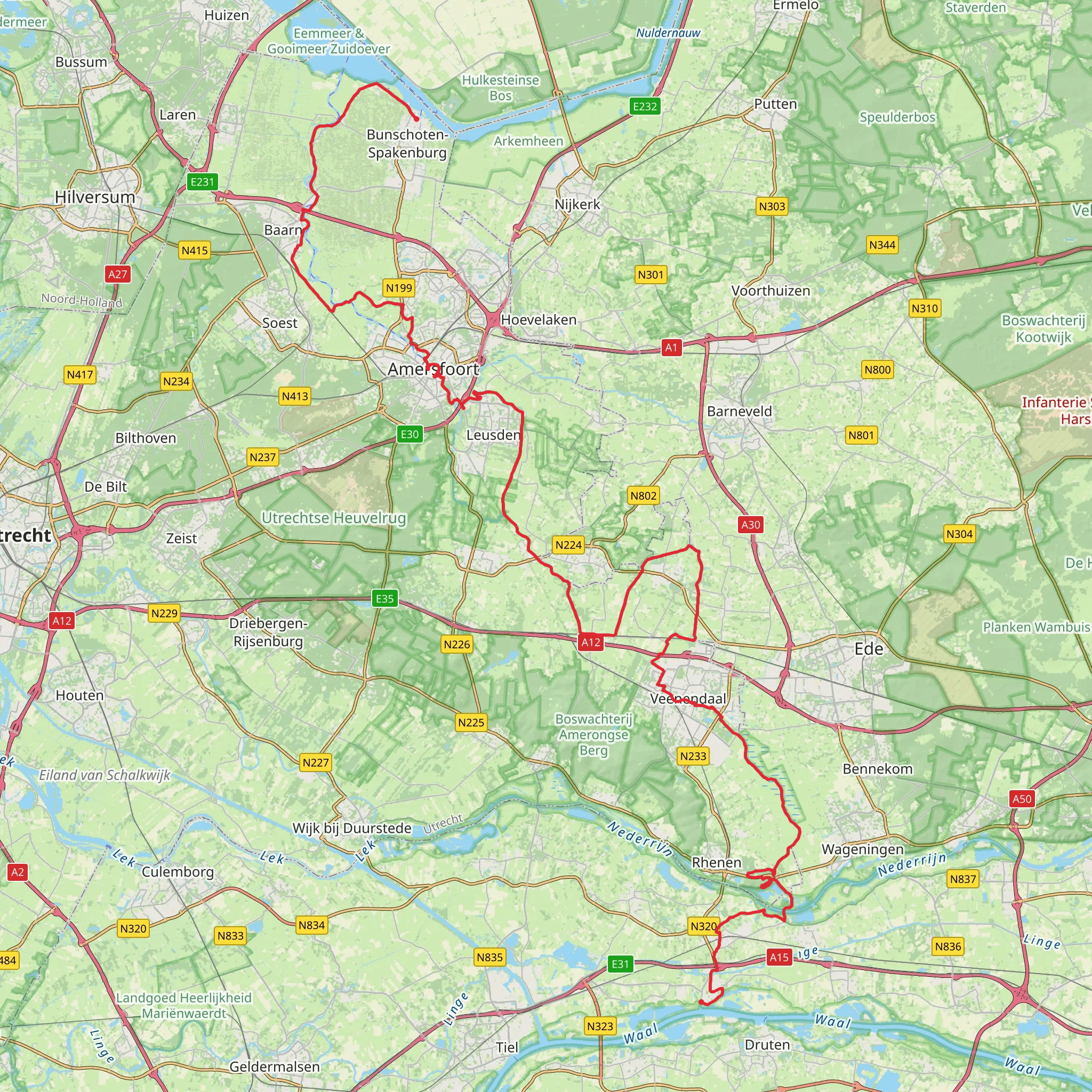
This is a long, low-elevation point-to-point walk through the heart of the Dutch river landscape: village streets and dikes, wide polder views, drainage canals, and historic waterside towns. At around 91 km (56.5 mi) with roughly 100 m (330 ft) of total ascent, the challenge is less about climbing and more about time on feet, wind exposure on open dikes, and staying comfortable on hard surfaces (a lot of this route is likely paved or compacted path).
Getting to the start (Ochten) and planning logistics
Start area (nearest landmark/address): Ochten is a village in Gelderland, Netherlands. A practical “pin” for meeting and supplies is Ochten village center near the church area (Dorpsstraat, Ochten)—this is typically where you’ll find basic services and a clear sense of orientation.
By public transport (typical approach): - The nearest larger rail hubs in this region are usually Tiel and Kesteren (both commonly used for Betuwe-area access). From there, local buses generally connect to surrounding villages like Ochten. Check current schedules and stops in your journey planner, then use HiiKER to align the bus stop with your intended start point.
By car: - Driving is straightforward in the Betuwe: you’ll be using regional roads between the A15 corridor and the villages along the Waal/Rhine system. Park considerately in public parking areas near the village center (look for signed parking near community facilities), and avoid blocking farm access lanes and dike maintenance gates.
End area (Oude Haven): “Oude Haven” (“Old Harbor”) is a common harbor name in Dutch towns. For your finish logistics, treat the endpoint as the Old Harbor waterfront area of the destination town (a recognizable quay/harbor basin with restaurants, moorings, and pedestrian promenades). If you share the endpoint town name (or a GPX), I can translate the final coordinates into the nearest exact street/landmark and suggest the cleanest return transport plan.
Time and staging: - At an easy all-day pace (including breaks), many hikers plan 25–35 km (15.5–21.7 mi) per day, making this a 3–4 day outing for most people. - If doing it in one push, you’re looking at a very long day—plan for early start, lights, and a firm cutoff time.
What the terrain feels like (and why it’s “easy” but still demanding)
Expect flat to gently rolling ground with small rises where you transition onto dikes, bridges, and raised roads. The “easy” rating fits the elevation profile, but the route can be deceptively tiring because: - Hard surfaces (asphalt, brick, concrete) can dominate—bring footwear with cushioning and consider blister prevention early. - Wind is often the biggest “hill” in Dutch lowlands. Open dikes and polder roads can feel relentless in headwinds. - Long, straight sections can be mentally taxing—break the day into segments between villages, locks, bridges, and cafés.
Route character and landmarks you’re likely to pass
From Ochten, the route name suggests you’ll stitch together local connectors—Hoofdstraat (often the main street through a village), waterways like Bisschop Davidsgrift (a drainage canal/“grift”), and dike roads such as Groeperkade (“kade” indicates a dike/embankment).
A sensible way to think about the day-by-day flow:
0–20 km (0–12.4 mi): village edges and orchard country - Leaving Ochten, you’ll likely move through residential lanes and farm access roads before the landscape opens into Betuwe-style agriculture—orchards, hedgerows, and drainage ditches. - In spring, blossom season can be spectacular; later in the year, expect fruit production activity and occasional farm traffic.
20–55 km (12.4–34.2 mi): canals, grifts, and long dike lines - Following a “grift” corridor typically means straight, engineered water management lines—excellent for navigation but exposed. - You’ll cross frequent small bridges, culverts, and sluice structures. These are good micro-landmarks to confirm progress in HiiKER when everything looks similar for kilometers at a time. - Watch for maintenance vehicles on dikes and narrow lanes; step aside early—verges can be soft.
55–91 km (34.2–56.5 mi): approaching the harbor town - As you near an “Oude Haven” area, the route usually becomes more urban: quays, older street grids, and waterfront infrastructure. - Surfaces become more consistently paved, and you’ll encounter more cyclists and pedestrians—stay predictable and keep right on shared paths.
Nature, wildlife, and what to look out for
This region is shaped by the Netherlands’ long relationship with rivers and reclaimed land. Even when you’re not right beside a major river, the water table and drainage network are always present.
Common sightings and seasonal highlights: - Waterbirds: mallards, coots, moorhens, herons, and geese along canals and ditches. In wetter fields, you may see waders. - Raptors: kestrels and buzzards often hover over open fields. - Small mammals: hares and rabbits in field margins; occasionally roe deer near quieter edges. - Insects: in warm months, expect mosquitoes/gnats
AI Planner
Days planned around your pace, with somewhere to stay each night.
Surfaces
Asphalt
Unknown
Grass
Dirt
Ground
Unpaved
Concrete
Gravel
Sand
Paved
Wood
Comments and Reviews
User comments, reviews and discussions about the Ochten to Oude Haven via Hoofdstraat, Bisschop Dvidsgrift and Groeperkade, Netherlands.
average rating out of 5
0 rating(s)



