
Download
3D Flyover
Add to list
More
16.6 km
~3 hrs 28 min
94 m
Loop
“Winding from vibrant Maastricht to serene riverbanks, this trail dazzles with scenic vistas and layered history.”
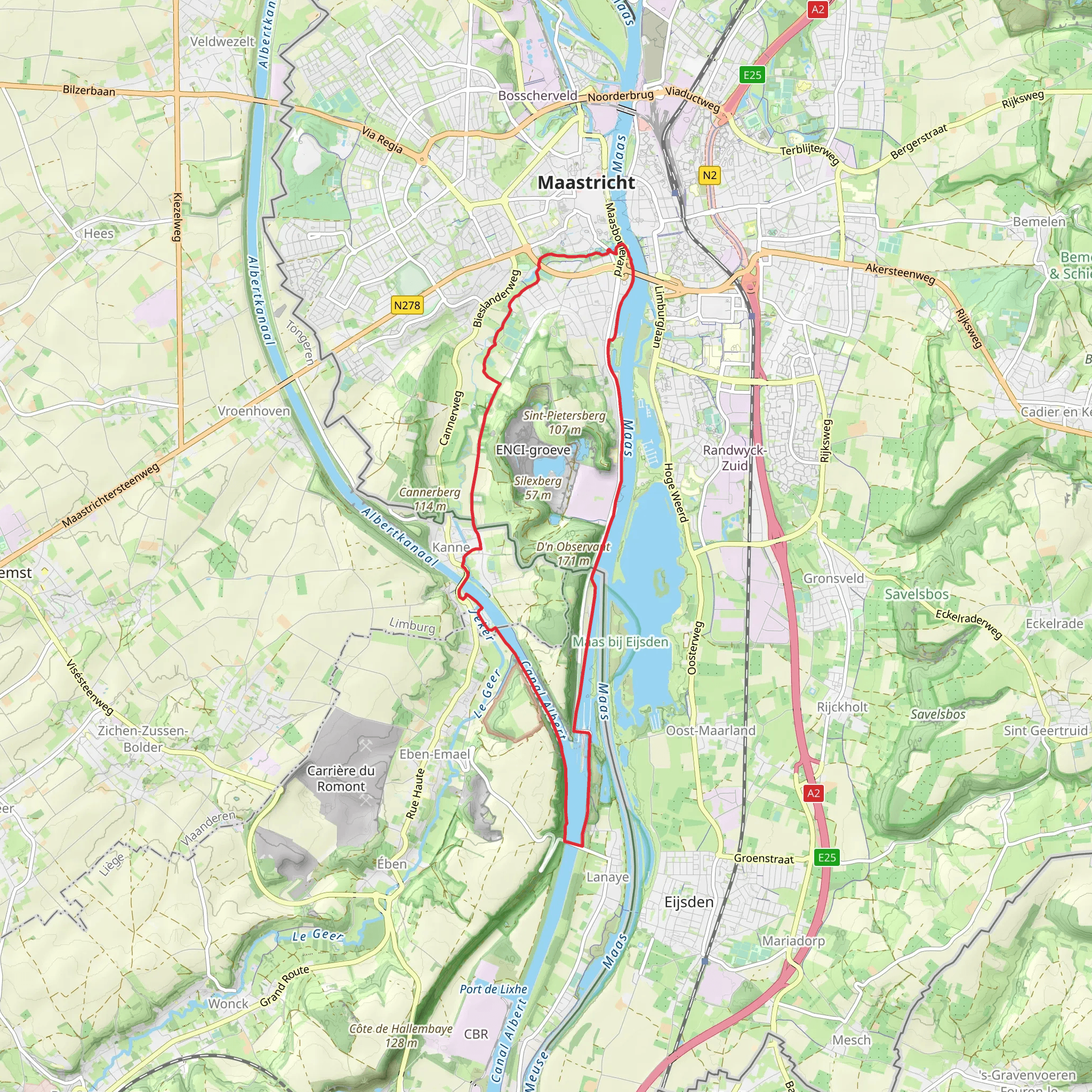
Embarking on the Maas and Albertkanaal segment of the Dutch Mountain Trail offers a captivating 17-kilometer (approximately 10.5-mile) journey through the picturesque landscapes of the Netherlands and Belgium. With an elevation gain of around 100 meters (328 feet), this trail is accessible to hikers of varying skill levels.
Starting Point and Access
The trail commences in Maastricht, a vibrant city in the southern Netherlands. For those arriving by public transport, Maastricht Central Station serves as a convenient access point. From the station, it's a short walk to the Hoge Brug (High Bridge), where the trail begins. If traveling by car, parking is available near the station or in designated areas within the city.
Trail Overview
Beginning at the Hoge Brug, hikers cross the Maas River and proceed through Maastricht's scenic city park, following the river southward. The path leads to the base of St. Pietersberg, home to the former ENCI marl quarry, now transformed into a nature and recreation area. A notable feature here is the observation platform overlooking the quarry, which also marks the endpoint of the renowned Pieterpad trail.
Key Landmarks and Natural Features
D'n Observant Summit: After descending through the quarry and traversing a section of marl caves, the trail ascends to D'n Observant, an artificial hill standing at 157 meters (515 feet). This summit offers panoramic views of the surrounding Belgian landscape.
Lanaye Locks: The descent from D'n Observant leads to the Lanaye Locks on the Belgian side. These impressive locks manage a 14-meter (46-foot) water level difference between the Maas River and the Albertkanaal, showcasing remarkable engineering.
Maas River Path: Continuing along the Maas River, the trail passes through the charming village of Eijsden, known for its white houses and inviting terraces. Here, hikers can view Kasteel Eijsden, a picturesque castle near the riverbank.
Historical Significance
The region is steeped in history, with the Maas River serving as a vital trade route and natural border for centuries. The Lanaye Locks, constructed in the early 20th century, were pivotal in facilitating coal and steel transport from Liège to the port of Antwerp. Additionally, the area around St. Pietersberg has been shaped by centuries of marl extraction, leaving a unique geological and cultural imprint.
Wildlife and Nature
Hikers can expect to encounter diverse flora and fauna along the trail. The St. Pietersberg area, now a nature reserve, is home to various bird species, including peregrine falcons. The riverbanks of the Maas and Albertkanaal provide habitats for waterfowl and other aquatic life.
Navigation and Preparation
While the Dutch Mountain Trail is marked, signage may not always be consistent. It's advisable to use navigation tools like HiiKER to ensure accurate route tracking. Given the trail's moderate length and elevation gain, sturdy hiking shoes and weather-appropriate clothing are recommended. Be prepared for some steep ascents and descents, particularly around D'n Observant and St. Pietersberg.
Transportation and Logistics
Public transport options are available at both the start and end points of the trail. Maastricht Central Station offers connections to various Dutch cities, while Eijsden has a train station with services to Maastricht and beyond. For those driving, parking is available near Maastricht Central Station and in Eijsden.
Embarking on this segment of the Dutch Mountain Trail provides a blend of natural beauty, historical landmarks, and cultural experiences, making it a rewarding journey for any hiking enthusiast.
AI Planner
Days planned around your pace, with somewhere to stay each night.
Surfaces
Asphalt
Unknown
Concrete
Dirt
Grass
Ground
Unpaved
Wood
Comments and Reviews
User comments, reviews and discussions about the Maas and Albertkanaal via Dutch Mountain Trail, Netherlands.
average rating out of 5
0 rating(s)



