Download
3D Flyover
Add to list
More
44.8 km
2 days
120 m
Multi Day
“A long, wind-brushed Drenthe loop of lanes, heath, and pine—sandy, muddy, quietly demanding.”
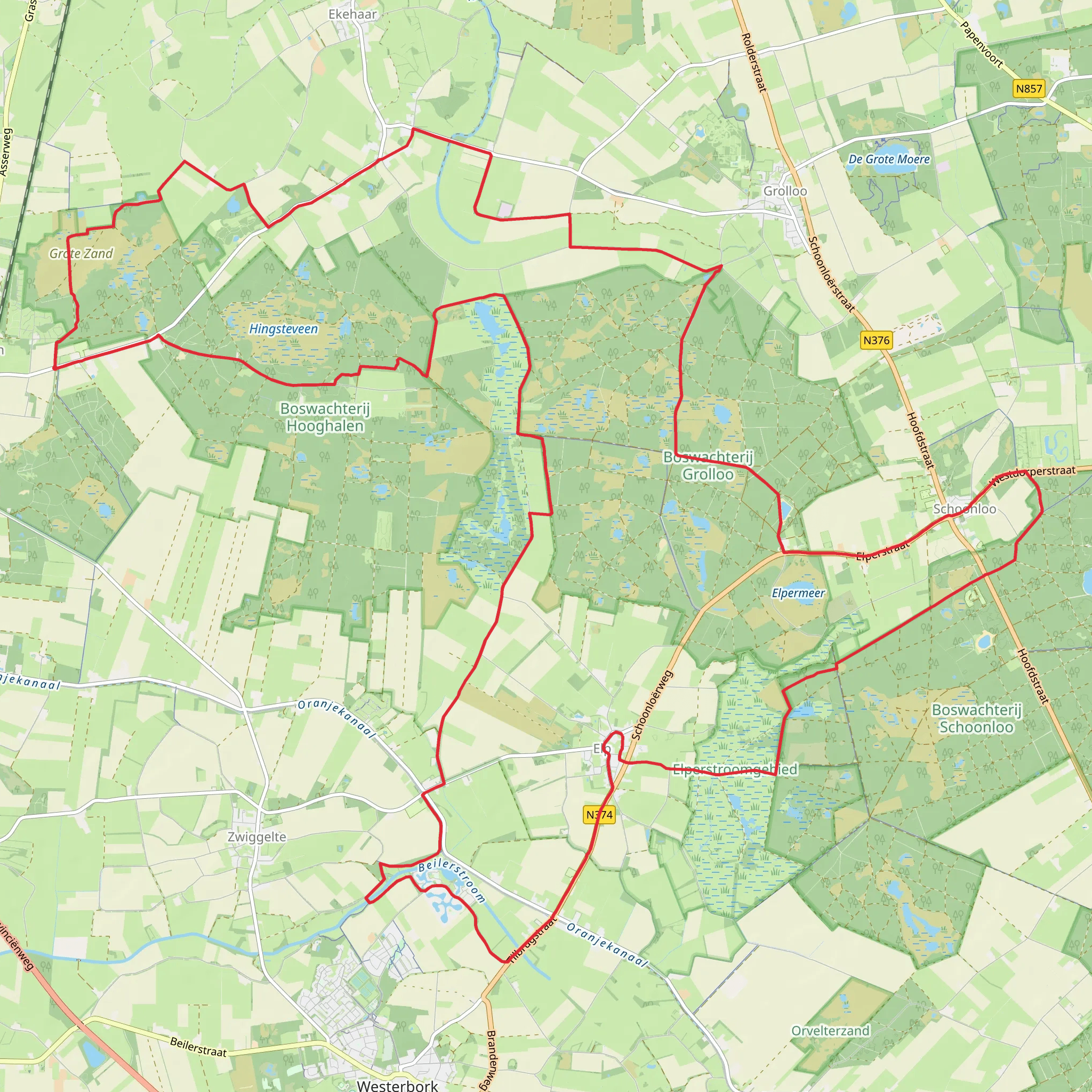
This is a long, low-relief loop of roughly 45 km (28 miles) with about 100 m (330 ft) of total ascent—more of an endurance day than a climbing day. Expect a mix of quiet Drenthe countryside, straight farm lanes, sandy tracks, and long, level paths through heath and pine woodland. Because the elevation gain is modest, the main challenges tend to be distance, wind exposure across open fields, and underfoot conditions (sand, mud, and occasional slick brick/boardwalk sections depending on season).
Where the hike starts (and what “near” likely means)
The route name points strongly to the villages/roads of Elp, Oosthalen, and the Elperstraat road corridor in Drenthe, Netherlands, in the wider area between Westerbork and Hooghalen. A practical “nearest known landmark” for a start/finish that fits this loop style is the village center of Elp (near the church and village green) or a roadside pull-off along Elperstraat between Elp and Oosthalen. If you share the exact coordinates (or a map link), I can pin this to the nearest specific address/landmark precisely.
Getting to the start (car + public transport)
By car - Drenthe is very car-friendly for rural loops. Aim for parking in/near Elp village (small village parking areas) or near a public facility (community hall/sports field) if available. In rural Drenthe, parking is often informal but still regulated—avoid blocking farm gates and field access.
By public transport - The most reliable rail hub nearby is typically Assen (larger station) or Beilen (closer to Westerbork area). From there, you’re usually looking at a regional bus toward Westerbork / Hooghalen / Elp and then a short walk to the start. - Bus frequencies can be limited outside commuting hours; plan around a timetable and keep a buffer for the return. Use HiiKER to align the loop start with the nearest bus stop and to confirm the best “bail-out” points if you need to shorten the day.
What the terrain feels like over 45 km / 28 miles
- Surface: a rotating mix of paved farm roads, hard-packed gravel, sandy forest tracks, and occasional heathland paths. After rain, sandy sections can turn soft and energy-sapping; clayey edges and forest hollows can hold water.
- Gradient: almost entirely gentle. You’ll notice “micro-undulations” (old drift ridges, field margins, and forest track rises) rather than any sustained climb.
- Exposure: open agricultural stretches can be windy. In cooler months, wind chill can matter more than temperature.
Landmarks, landscape, and the character of Drenthe
This part of Drenthe is known for its esdorpen (traditional village landscapes), heath remnants, and managed forests. Over a full-day loop like this, the scenery tends to come in broad chapters:
Farmland lanes and village edges
Early and late in the loop you’ll likely pass farmsteads, drainage ditches, and long straight lanes typical of the region’s agricultural layout. Look for: - Old field boundaries and tree lines that break the wind. - Canals/ditches with reed beds—good spots for birds, but also where paths can be slick on the edges.
Heath, pine woodland, and sandy tracks
Between villages, the route often transitions into conifer plantations and mixed woodland with sandy underfoot sections. These are classic Drenthe walking conditions: - Sandy stretches can slow your pace noticeably over 45 km (28 miles). - Woodland can feel sheltered, but junctions can be repetitive—keep an eye on your position in HiiKER, especially where multiple forestry tracks intersect.
Wildlife you may see (and what to watch for)
- Roe deer are common in woodland edges and quiet fields, especially at dawn/dusk.
- Foxes and hares are possible along field margins.
- Birdlife is often the highlight: buzzards, kestrels, and a variety of songbirds; wetter margins can hold herons and waterfowl.
- Ticks can be a real consideration in heath/rough grass and woodland understory in warmer months—long socks/trousers and a post-hike check help.
- In rural areas, you may encounter grazing livestock (cattle/sheep) on or near paths; give space and keep a calm, wide line around them.
Historical context to enrich the walk
Drenthe is one of the Netherlands’ most historically layered provinces. Even when a route doesn’t pass a single “big monument,” you’re walking through a landscape shaped by: - Peat extraction and reclamation: much of the region’s land use and straightened routes reflect centuries of drainage and cultivation. - Ancient settlement patterns: villages like Elp and nearby communities often sit within long-established agricultural zones. - Wartime history nearby: the broader area around Westerbork is closely associated with the history of Kamp Westerbork (a major WWII transit camp). Depending on the exact line of your loop, you may be within reachable distance of related memorial landscapes or interpretive sites. If you want, share your start point and I can tell you whether the loop passes close enough to incorporate a respectful detour.
Planning for an “easy” 45 km (28 miles) day
Even with only **
AI Planner
Days planned around your pace, with somewhere to stay each night.
Surfaces
Asphalt
Concrete
Unknown
Sand
Wood
Unpaved
Comments and Reviews
User comments, reviews and discussions about the Elperstraat, Elperstraat and Oosthalen Loop, Netherlands.
average rating out of 5
0 rating(s)