
Download
3D Flyover
Add to list
More
41.3 km
2 days
87 m
Multi Day
“A long, lowland loop of lanes, farm tracks and woodland hush—where patience and navigation shine.”
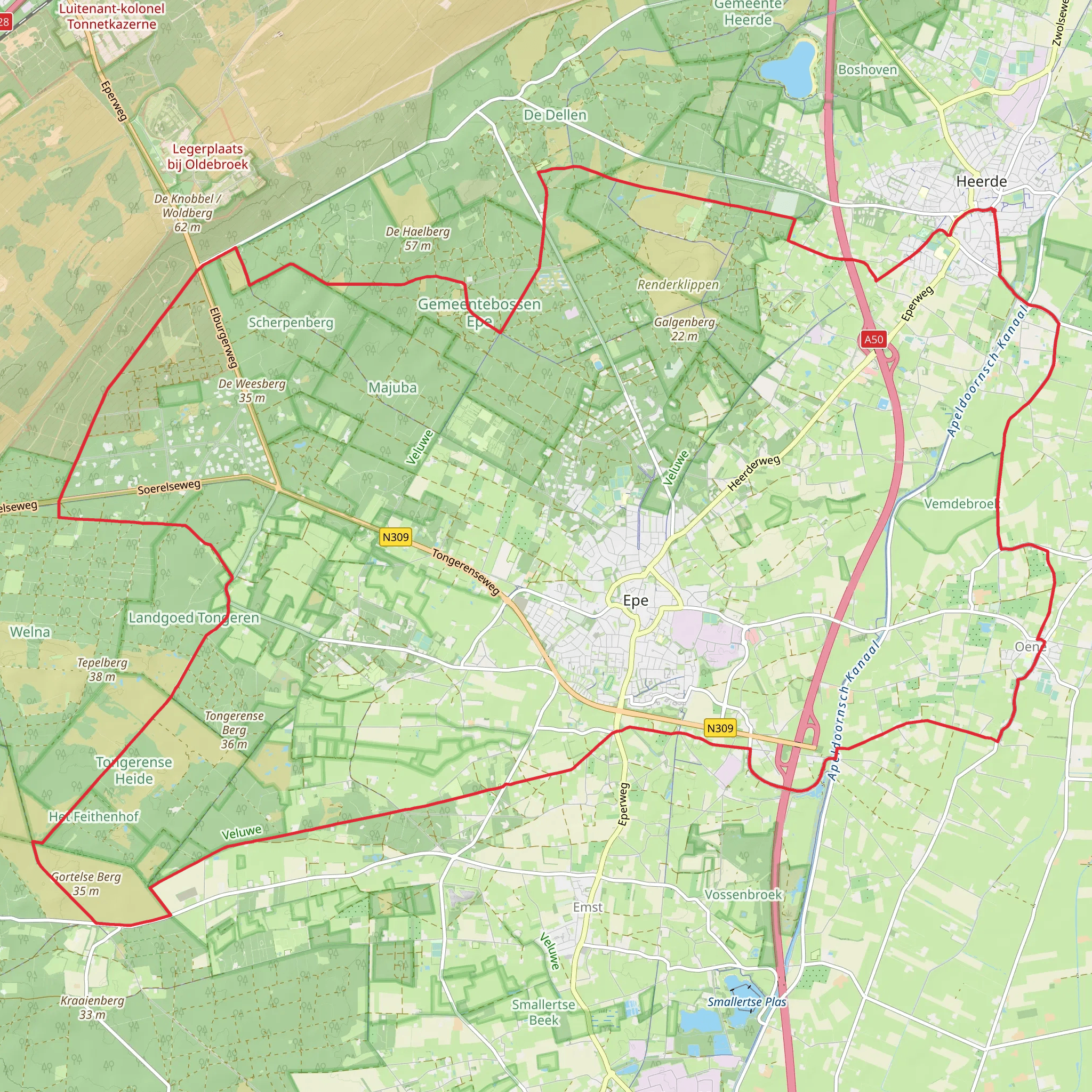
This is a long, low-relief loop (about 41 km / 25.5 mi with roughly 100 m / 330 ft of total ascent) that’s more about steady forward progress than climbing. Expect a mix of quiet country lanes, farm tracks, and wooded path segments, with frequent junctions where paying attention to wayfinding matters more than fitness. Because the elevation gain is modest, the main challenges tend to be time-on-feet, surface changes (paved lanes to soft tracks), and seasonal mud in low-lying sections.
Getting to the start (car + public transport)
Because the start is only listed as “near” (no coordinates provided), the best approach is to anchor your start at the nearest village center or a signed trail access point/parking area once you share a pin. If you can provide a lon/lat, I’ll convert it to the nearest known address or landmark and tailor the directions precisely.
For planning purposes in this region, typical access looks like this: - By car: Aim for a village center car park, a church square, or a signed recreation/trailhead parking area near the loop. Arrive early—on weekends, small village parking fills quickly, and roadside parking may be restricted along narrow agricultural lanes. - By public transport: Use rail to the nearest regional station, then a local bus toward the closest village on the loop. In rural areas, buses can be infrequent (especially Sundays), so check the last return service before committing to the full distance. If service is sparse, consider starting/finishing near a busier village on the route so you’re not locked into one timetable.
If you send the start coordinates (or the nearest town name), I can also suggest the most reliable “bail-out” points where buses are more likely.
What the route feels like underfoot
With only about 100 m / 330 ft of ascent spread across 41 km / 25.5 mi, the loop generally rolls rather than climbs. You’ll likely notice: - Long flat stretches where pace is consistent and it’s easy to underestimate fatigue. - Frequent transitions: short wooded connectors, then open farmland, then lanes again. - Hard-surface mileage: even “easy” terrain can feel tougher late in the day if there’s a lot of pavement—plan footwear accordingly (cushioning helps).
Because the route strings together multiple named paths/ways, expect many intersections. Have the route loaded in HiiKER and be ready for quick checks at every major junction—especially where a farm track splits into two similar-looking lines.
Landmarks, landscape, and the character of the area
This loop’s highlights are typically subtle and atmospheric rather than dramatic: - Wooded pockets and hedgerows break up the open sections and can be rich in birdsong. In spring and early summer, you’ll often hear (and sometimes see) a lot of small passerines along field edges. - Agricultural scenery dominates: broad fields, drainage ditches, and farmyards. These areas can be beautiful in changing light, but they’re also exposed—wind and sun can be more of a factor than elevation. - Small hamlets and rural lanes provide natural “checkpoints” for pacing and navigation. They’re also your best opportunities to top up water if there’s a café, shop, or public tap—though you should not rely on these being open.
Nature and wildlife to look out for
Wildlife sightings vary by season and time of day, but on a lowland rural loop like this, common encounters include: - Deer at woodland margins (most likely early/late). - Raptors (buzzards/kestrels) hovering over fields. - Water-associated birds near ditches and wet patches—listen for calls before you see them. - Ticks in taller grass and along scrubby edges in warmer months: use repellent, wear long socks, and do a check at breaks and at the end of the hike.
You’ll also pass through working farmland. Expect: - Electric fencing and livestock in some sections—keep distance and follow posted guidance. - Dogs on leads are often required near grazing areas; even if not required, it’s wise.
Historical context you can feel on the walk
Routes stitched from multiple “-pad” and “-weg” segments often reflect older local movement corridors—paths between farms, hamlets, and market villages that predate modern roads. Even when you’re on a quiet lane today, the alignment can hint at long-standing land use: field boundaries, drainage patterns, and the placement of farmsteads often follow historical property lines. If the loop passes any chapels, old farm complexes, or boundary stones, treat them as more than scenery—they’re markers of how the landscape was organized and traveled for generations.
If you share the nearest town or coordinates, I can identify any specific heritage sites (mills, chapels, estates, historic farmsteads, or protected landscapes) that the loop passes close to and describe what to look for.
Practical planning: time, food, water, and pacing
For 41 km / 25.5 mi on easy terrain, many hikers plan roughly: - 7–10 hours moving time, depending on pace and surface. - Add 1–2 hours for breaks, photos, navigation checks, and any café stops.
Food/water: - Bring enough calories for a full-day effort (think 300–500 kcal per hour as a rough planning range). - Carry at least 1.5–2.5 L of water depending on temperature and your
AI Planner
Days planned around your pace, with somewhere to stay each night.
Surfaces
Concrete
Asphalt
Unknown
Sand
Grass
Ground
Comments and Reviews
User comments, reviews and discussions about the Renderklippenpad, Koekenbergweg and Kamperweg Loop, Netherlands.
average rating out of 5
0 rating(s)


