
Download
3D Flyover
Add to list
More
14.5 km
~3 hrs 4 min
100 m
Point to Point
“From village lanes past Roman echoes to wind-swept Mookerheide heath, a gently adventurous day walk.”
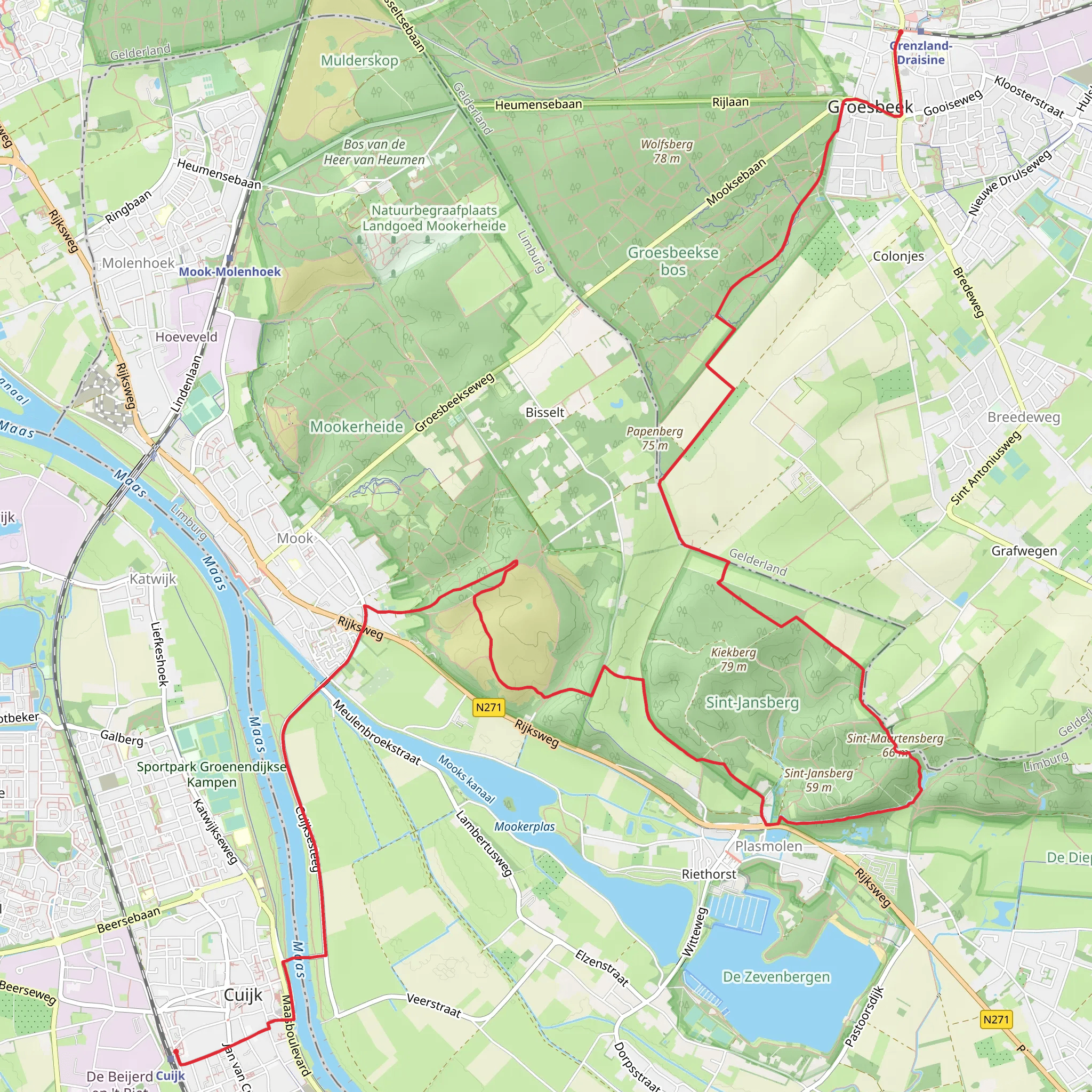
This is a point-to-point walk of roughly 15 km (9.3 mi) with about 100 m (330 ft) of total ascent—mostly gentle, with one noticeably “hilly” section when you cross the Mookerheide heathland ridge. Underfoot you’ll get a classic mix for this part of the Netherlands: paved village paths and cycleways, compacted farm tracks, sandy/heathy footpaths, and short woodland stretches. It’s well-suited to an easy day out, but it can feel more demanding in wind or after rain when sandy sections soften and the heath paths get slick.
Getting to the start (Centrum) and back from Cuijk
Start area (nearest landmark): the most practical “Centrum” start point for this route is around Mook town center, near Mook-Molenhoek railway station and the village core (think the area around the station and main village streets in Mook, Limburg, Netherlands). If your “Centrum” is intended to be a different town center, tell me which municipality and I’ll pin it to the nearest obvious landmark.
- By public transport:
- Take the train to Mook-Molenhoek (on the Nijmegen–Roermond corridor). From the station, you can walk straight into the village center to pick up the route.
- From Cuijk, trains run to Nijmegen and onward connections are straightforward, making the point-to-point format convenient.
- Take the train to Mook-Molenhoek (on the Nijmegen–Roermond corridor). From the station, you can walk straight into the village center to pick up the route.
- By car:
- Park near Mook-Molenhoek station or signed public parking in/near the village center (look for municipal lots). For the finish, Cuijk station area also has parking if you prefer to shuttle cars.
For navigation, load the route in HiiKER and download offline maps—useful on the heath where multiple sandy tracks can look similar.
You’ll want: comfortable walking shoes (trail runners are fine in dry weather), a light wind layer for exposed heath, and a small snack/water plan (villages are frequent enough that you’re rarely far from services, but not always right on the path).
What the walk feels like, section by section
0–4 km (0–2.5 mi): Village edges, fields, and “Klein Amerika”
Leaving the center area, the route typically threads through residential edges into open farmland. Expect flat walking with only small rises—maybe 10–20 m (30–65 ft) of gain total in this early stretch. “Klein Amerika” in this region is a local place-name you’ll often see attached to a lane/area rather than a single “site,” so treat it as a waypoint zone: a quiet rural pocket with long views across fields and drainage lines.
Look out for:
- Cyclists on shared paths—this is a heavily bike-oriented area, and some lanes are effectively cycle highways.
- Seasonal mud on farm access tracks after rain; the surface can be slick where tractors cut ruts.
Wildlife is subtle but present: you may see hares, pheasants, and small raptors (kestrels are common over open fields). In spring and early summer, field margins can be lively with songbirds.
4–8 km (2.5–5.0 mi): Roman-era traces — “Ruine Romeinse Villa”
As you approach the Roman villa ruins waypoint, the walking remains easy and mostly level, but the scenery shifts toward more wooded edges and slightly sandier soils. The “Ruine Romeinse Villa” reference points to the Roman presence that shaped this broader region: the Netherlands’ river corridors and nearby higher grounds were strategically important in the Roman period, with villas and rural estates supporting agriculture and supply networks. Even when the visible remains are modest, it’s a meaningful reminder that this landscape has been intensively used for nearly two millennia.
Practical notes here: - Ruins/archaeological spots are often protected—stay on the path, don’t climb on masonry or earthworks, and respect any fencing or signage. - If you’re using HiiKER, zoom in around the waypoint: small spur paths can tempt you off-route.
8–12 km (5.0–7.5 mi): Mookerheide — the “hilliest” part
This is where the route earns most of its ascent. The Mookerheide is a heathland and woodland mosaic with sandy tracks and low ridgelines. Over these kilometers you may gain roughly 60–80 m (200–260 ft) in a series of gentle climbs rather than one steep push. The payoff is a more “upland” feel than most people expect in the Netherlands: open heath, scattered pines and birch, and broader views when the vegetation thins.
What to expect underfoot and in the air: - Sandy, braided paths: multiple parallel tracks form where people skirt puddles or soft sand. This is the one place you’re most likely to drift off the intended line—keep an eye on HiiKER. - Wind exposure: the heath can feel noticeably cooler and windier than the sheltered village sections. - Ticks: in warm months, heath and edge-of-woodland grasses can carry ticks. Long socks and a quick check afterward are sensible.
Nature highlights: - Heathland plants (seasonal): heather and acid-soil grasses; late summer can bring the classic purple bloom. - Birds: listen for woodpeckers in the wooded patches and watch for buzzards circling on thermals. - Mammals: roe deer are possible at quieter times, especially near
Surfaces
Unknown
Asphalt
Unpaved
Sand
Concrete
Dirt
Grass
Paved
Comments and Reviews
User comments, reviews and discussions about the Centrum to Cuijk via Klein Amerika, Ruine Romeinse Villa and Mookerheide, Netherlands.
average rating out of 5
0 rating(s)



