
Download
3D Flyover
Add to list
More
16.0 km
~3 hrs 11 min
0 m
Loop
“A breezy waterside loop through reedbeds and wide lakes—big skies, slick edges, and wind-led reflections.”
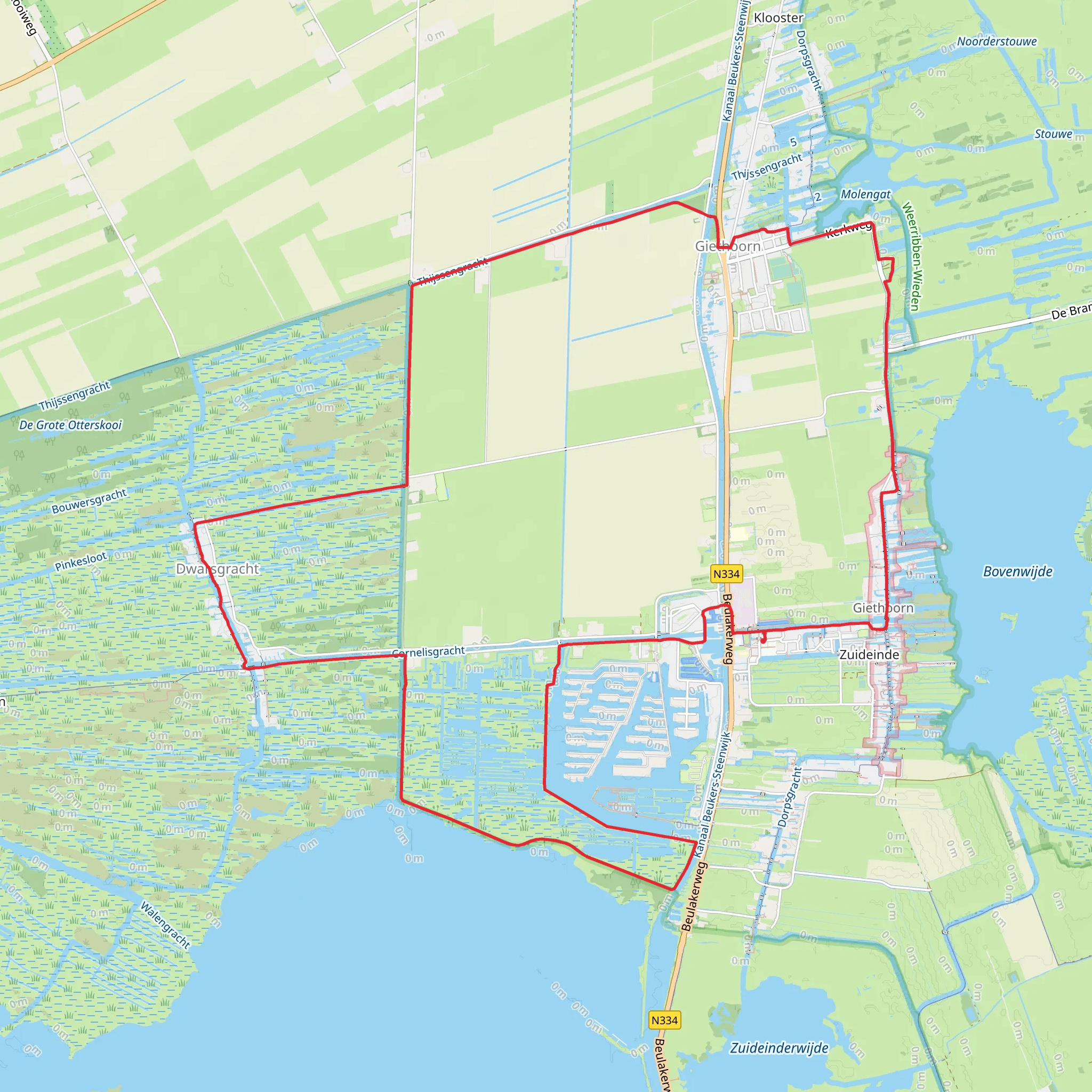
This easy, mostly level loop of about 16 km (10 miles) with roughly 0 m (0 ft) of climbing traces the watery edge of De Wieden / Weerribben-Wieden landscape—wide reedbeds, open lakes, and narrow ditches—linking the Molengat and Beulakerwijde waters via quiet lanes and paths such as Oude Kerkweg, Jonenweg, and Bodelaekepad. Expect big skies, constant water views, and classic Dutch lowland scenery where the “challenge” is less about hills and more about wind, exposed shorelines, and occasionally soft or slick path surfaces.
Getting to the start (car + public transport)
Because the start is listed only as “near,” the most practical approach is to aim for a well-known access point on this loop’s corridor:
- By car: Head toward Giethoorn / Jonen (Overijssel, Netherlands) and park near the Bodelaeke / Beulakerwijde waterfront area (a common access zone for the Bodelaekepad and lakeside walking). Look for public parking around the Giethoorn-Bovenwijde / Bodelaeke side where walking paths meet the water and holiday-park roads; parking rules can be strict in peak season, so use posted signs and pay stations where present.
- By public transport: The usual rail hub is Steenwijk (regional trains). From there, buses commonly run toward Giethoorn. Once in Giethoorn, you can walk to the lakeside path network or take a short taxi/ride-share to the nearest trail access by the Beulakerwijde/Bodelaeke edge. Plan extra time in summer weekends when buses and roads are busy.
If you share the lon/lat for the trailhead (or a GPX), I can convert it to the nearest named place/address/landmark and tailor the directions precisely.
What the route is like (distance markers you can plan around) - Total: ~16 km (10 miles) - Elevation: ~0 m (0 ft) (expect only tiny rises on dikes/bridges) - Time planning: Many hikers take 3.5–5 hours depending on photo stops, wind, and how wet the path edges are. - Surface: A mix of paved farm lanes, dike-top paths, and compact gravel/earth sections near water. After rain, some stretches can be muddy or have slick algae on hard edges near canals.
A sensible way to think about the loop is in three broad legs:
1) Oude Kerkweg sector (first ~4–6 km / 2.5–3.5 miles)
You’ll likely begin on quiet rural lanes with drainage ditches on either side. This is classic reclaimed wetland country: straight lines, water management infrastructure, and long views. Even though the elevation gain is negligible, you may feel resistance from headwinds—a bigger factor than terrain here.
2) Jonenweg and the transition to open water (middle ~5–7 km / 3–4.5 miles)
As you angle toward Jonen and the broader lake margins, the landscape opens. Jonen is a small settlement tied historically to peatland use and water-based transport. You’ll notice how the road/path network threads between reedbeds and open water, with occasional bridges and culverts—good places to pause, check your position in HiiKER, and scan for birds.
3) Bodelaekepad and Beulakerwijde edge (final ~4–6 km / 2.5–3.5 miles)
This is where the “big water” feeling peaks. The Beulakerwijde is one of the larger lakes in the area, and the Bodelaekepad typically keeps you close to the shoreline environment. Expect more people near access points (especially in holiday season), plus cyclists on shared segments. Wind can be strongest here; in cooler months it can feel significantly colder than the air temperature suggests.
Landmarks, landscape character, and why this area looks the way it does This region is part of a famous Dutch wetland system shaped by peat extraction and centuries of water management. Many of the lakes and open waters in Weerribben-Wieden owe their form to historical peat cutting: excavations filled with water, widened by storms and wave action, and later managed through dikes, canals, and reed cultivation. The result is a mosaic of: - Reedbeds (rietlanden) used historically for thatching and still managed in places - Open lakes like Beulakerwijde, with broad horizons and active boating - Narrow canals and ditches that reveal the engineered nature of the landscape
You’ll also pass through areas where the built environment is subtly adapted to wet ground—raised edges, drainage channels, and carefully maintained banks.
Nature and wildlife to look out for This is prime wetland habitat. Even on a short loop, you can see a lot—especially if you slow down near reed edges and quieter backwaters.
- Birdlife: Expect waterfowl (ducks, geese, swans), plus reedbed specialists. In the Netherlands’ major wetlands, raptors and marsh birds are possible; bring binoculars if you have them.
- Mammals: Otter habitat exists in parts of these wetlands (they’ve been reintroduced in the broader region), though sightings are never guaranteed. You’re more likely to notice tracks, ripples, or quiet movement at dawn/dusk
AI Planner
Days planned around your pace, with somewhere to stay each night.
Surfaces
Concrete
Asphalt
Unknown
Paved
Wood
Comments and Reviews
User comments, reviews and discussions about the Molengat and Beulakerwijde via Oude kerkweg, Jonenweg and Bodelaekepad Loop, Netherlands.
average rating out of 5
0 rating(s)



