Download
3D Flyover
Add to list
More
12.0 km
~2 hrs 29 min
54 m
Loop
“From Kasteel Cannenburch, drift through Veluwe pines and heather edges, pausing in hushed sandy hollows.”
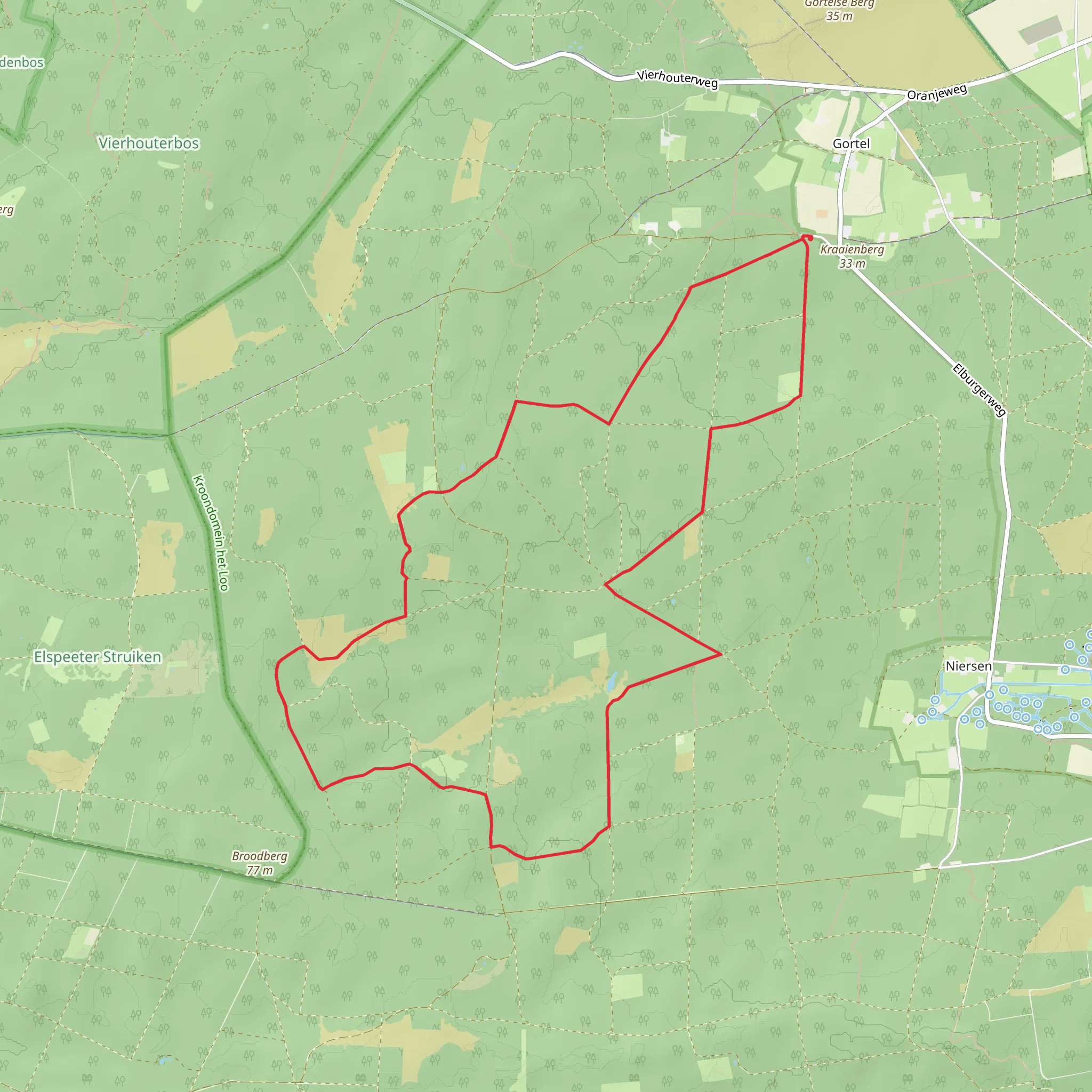
This easy loop is a classic Veluwe-style woodland walk: mostly flat, well-surfaced forest tracks mixed with narrower sandy paths, passing a trio of named hollows/pits (the “kuilen”) and quiet conifer–heath edges. At around 12 km / 7.5 mi with roughly 100 m / 330 ft of total ascent, it’s ideal for a half-day outing where the “effort” comes more from soft sand in places than from climbing.
What “near” the start likely means (nearest landmark/address) The place-names in the route—Cannenburgergat and Prinsenkuil—are strongly associated with the woods around Kasteel Cannenburch in Vaassen (Gelderland, Netherlands). The most practical, well-known start landmark is:
- Kasteel Cannenburch, Maarten van Rossumplein, 8171 EB Vaassen, Netherlands (castle and estate area; common trailhead zone)
If your GPX/start pin differs, share the coordinates and I’ll translate them to the nearest street/landmark precisely.
Getting to the start (car + public transport)
By car - Navigate to Kasteel Cannenburch (Maarten van Rossumplein, Vaassen). There are typically visitor parking options around the castle/estate area and nearby streets; arrive early on weekends/holidays when the Veluwe gets busy.
By public transport - The usual rail hub for this area is Apeldoorn. From Apeldoorn station, you can take a regional bus toward Vaassen and get off near the village/estate area, then walk a short distance to the castle grounds to pick up the loop. (Exact bus lines/timetables change—check current schedules before you go.)
What the terrain feels like (and why it’s “Easy”)
- Elevation: The “100 m / 330 ft” gain is spread out in tiny rises and dips—old dunes, forest banks, and shallow hollows—so you rarely notice sustained climbing.
- Underfoot: Expect a mix of packed forest road, needle-covered singletrack, and occasional loose sand. The sandy stretches can feel surprisingly tiring even on flat ground.
- Wayfinding: The woods can look repetitive. Load the route in HiiKER and keep an eye on junction density—there are often multiple parallel tracks that can lure you off-route.
Along the loop: landmarks, landscape, and what to look for
You’ll spend most of the day in Veluwe woodland mosaic—stands of pine and mixed deciduous patches, with openings that hint at heathland and older drift-sand landscapes. The three named features in the hike title are the highlights:
- Het Vorenhul: Typically refers to a local hollow/low-lying feature in the forest. These depressions often hold cooler, damper air—notice how mosses and shade plants can be more abundant here, and how the ground can stay soft after rain.
- Cannenburgergat: “Gat” in Dutch place-names often points to a pit, gap, or sandy hollow—frequently tied to historic sand extraction, drift-sand dynamics, or old trackways cutting through dunes. Expect a subtle bowl-like terrain change rather than a dramatic crater.
- Prinsenkuil: “Kuil” means pit/hollow. In Veluwe forests, these can be remnants of historic resource use (sand, turf, or small-scale extraction) or natural depressions later shaped by forestry tracks. They’re great spots to pause because they’re often sheltered from wind.
Nature and wildlife
This region’s forests are known for large mammals and birdlife typical of the central Netherlands’ sandy woodland belt:
- Deer (roe deer are common; red deer can occur in broader Veluwe areas): most likely at dawn/dusk along quiet edges and wider tracks.
- Wild boar: they can be present in Veluwe forests; look for rooted-up soil and churned leaf litter. Give them space—especially if you see striped piglets.
- Birds: woodpeckers, jays, and tits in the conifers; raptors may circle above clearings.
- Seasonal notes:
- Spring–summer: ticks are a real consideration in Dutch woodlands—use repellent, wear long socks, and do a check afterward.
- Late summer–early autumn: heather edges (where present) can add color; wasps can be active near picnic spots.
- Autumn–winter: leaf litter hides roots; after storms, expect occasional fallen branches across narrower paths.
- Spring–summer: ticks are a real consideration in Dutch woodlands—use repellent, wear long socks, and do a check afterward.
Effort, pacing, and approximate splits
For a relaxed pace with stops, plan 3–4 hours moving time, plus breaks.
A simple way to think about the loop:
- 0–4 km (0–2.5 mi): Settling into forest tracks; gentle undulations begin.
- 4–8 km (2.5–5 mi): The most “feature-dense” portion—more junctions, more subtle terrain bowls (the “gat/kuil” character).
- 8–12 km (5–7.5 mi): Quieter return through consistent woodland; often feels faster unless you hit soft sand.
Practical prep: what to bring and what to watch for
- Footwear: trail shoes are fine in dry weather; after rain, consider shoes with better grip for slick roots and muddy track edges.
- Water/snacks: there may be facilities near the castle/village,
Surfaces
Unknown
Gravel
Asphalt
Comments and Reviews
User comments, reviews and discussions about the Het Vorenhul, Cannenburgergat and Prinsenkuil Loop, Netherlands.
average rating out of 5
0 rating(s)