
Download
3D Flyover
Add to list
More
14.2 km
~2 hrs 50 min
0 m
Point to Point
“A wind-sculpted coastal loop from harbour hush to pine-sheltered dunes, ending by beach lanes.”
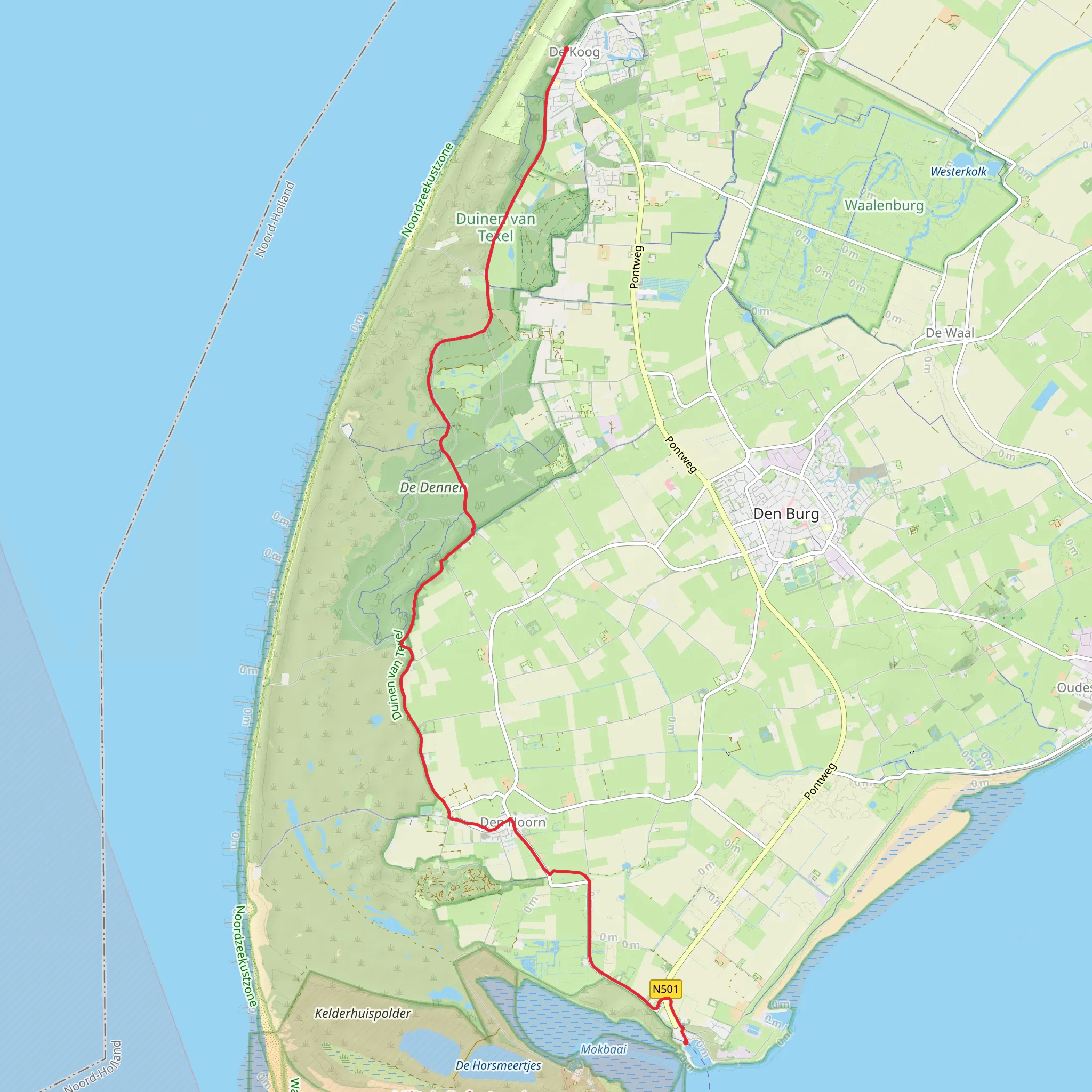
You’re looking at a very flat, coastal loop/through-walk of about 14 km (8.7 mi) with essentially 0 m (0 ft) of climbing—the kind of route where the “effort” comes more from wind, sand underfoot, and exposure than from hills. The terrain shifts between harbor edges, dune paths, piney shelterbelts (“De Dennen”), and open dune parkland (“Duinpark”), finishing near the Badweg—a common Dutch road name for the beach access corridor in seaside towns.
Getting to the start (Veerhaven)
Because “Veerhaven” simply means ferry harbor, there are multiple places in the Netherlands with that name. For this hike, the context points strongly to the Ouddorp / Goeree-Overflakkee coast (South Holland), near the Grevelingen and North Sea dune systems. Ouddorp itself sits on the island/municipality of Goeree-Overflakkee. (en.wikipedia.org)
By car - Aim for the Ouddorp coastal area and park near the harbor/ferry facilities if available, or at signed public lots near beach access points (often well-marked in Dutch coastal towns). - Roads in this region are straightforward but can bottleneck on sunny weekends and summer holidays.
By public transport - Typical approach is train to Rotterdam or another regional hub, then bus connections toward Ouddorp. Final access often involves a short walk from the nearest bus stop to the harbor area. - If you’re planning to incorporate a seasonal ferry crossing as part of a bigger day, note that local ferry services on the Grevelingen area can be seasonal and timetable-dependent, so check schedules before committing. (visitgo.nl)
If you share the lon/lat for “Hike head: near …”, I can pin it to the nearest specific address/landmark and tailor the transit/parking instructions precisely.
What the walk feels like underfoot (and how to pace it)
At 14 km / 8.7 mi, most hikers will take 3–4 hours moving time, plus stops. Expect: - Firm surfaces near the harbor and any paved connectors. - Compacted sand and dune tracks in Duinpark sections. - Occasional loose sand patches—these are the only places that can feel surprisingly tiring despite the flat profile.
Wind is the big variable. A calm day makes this feel like a gentle stroll; a stiff onshore breeze can make exposed dune stretches feel much longer.
Early kilometers: Veerhaven and the coastal edge
Starting near the harbor, you’ll likely spend the first 1–3 km (0.6–1.9 mi) on easy-going paths with open views and a “working coast” feel—water, boats, and low vegetation. Harbors on Goeree-Overflakkee are valued for their green edges, historic atmosphere, and clean surface water, and they often make pleasant early-route landmarks and rest points. (goeree-overflakkee.nl)
Use HiiKER to confirm the exact line through the harbor area—these places can have small detours around docks, private moorings, or seasonal works.
Middle section: De Dennen and Duinpark (dunes, shelter, and wildlife)
This is where the character changes and the walk becomes more “nature-forward,” typically over the next 7–10 km (4.3–6.2 mi) depending on the exact routing.
De Dennen (sheltered woodland feel)
“De Dennen” usually refers to pine-dominated dune woodland—planted or managed stands that create a noticeably calmer microclimate compared with the open dunes. Even when the wider landscape is windy, these sections can be quiet and sheltered, with softer light and more birdsong.
What to look for: - Transition zones where pines give way to scrub and open dune grassland—these edges are often the most wildlife-active. - Birdlife: expect common coastal woodland species (tits, finches, woodpecker-type habitats where mature trees exist), plus raptors riding the wind along dune edges. - Seasonal ground cover: in spring, fresh dune vegetation; in late summer/autumn, more seed heads and (in some dune woods) fungi.
Duinpark (open dunes and dynamic landscapes)
Duinpark sections tend to be more open: dune ridges, sandy hollows, and low shrubs. This is where you’ll feel the **North Sea influence
Surfaces
Concrete
Asphalt
Unknown
Gravel
Comments and Reviews
User comments, reviews and discussions about the Veerhaven to Badweg via De Dennen and Duinpark, Netherlands.
average rating out of 5
0 rating(s)

