Download
3D Flyover
Add to list
More
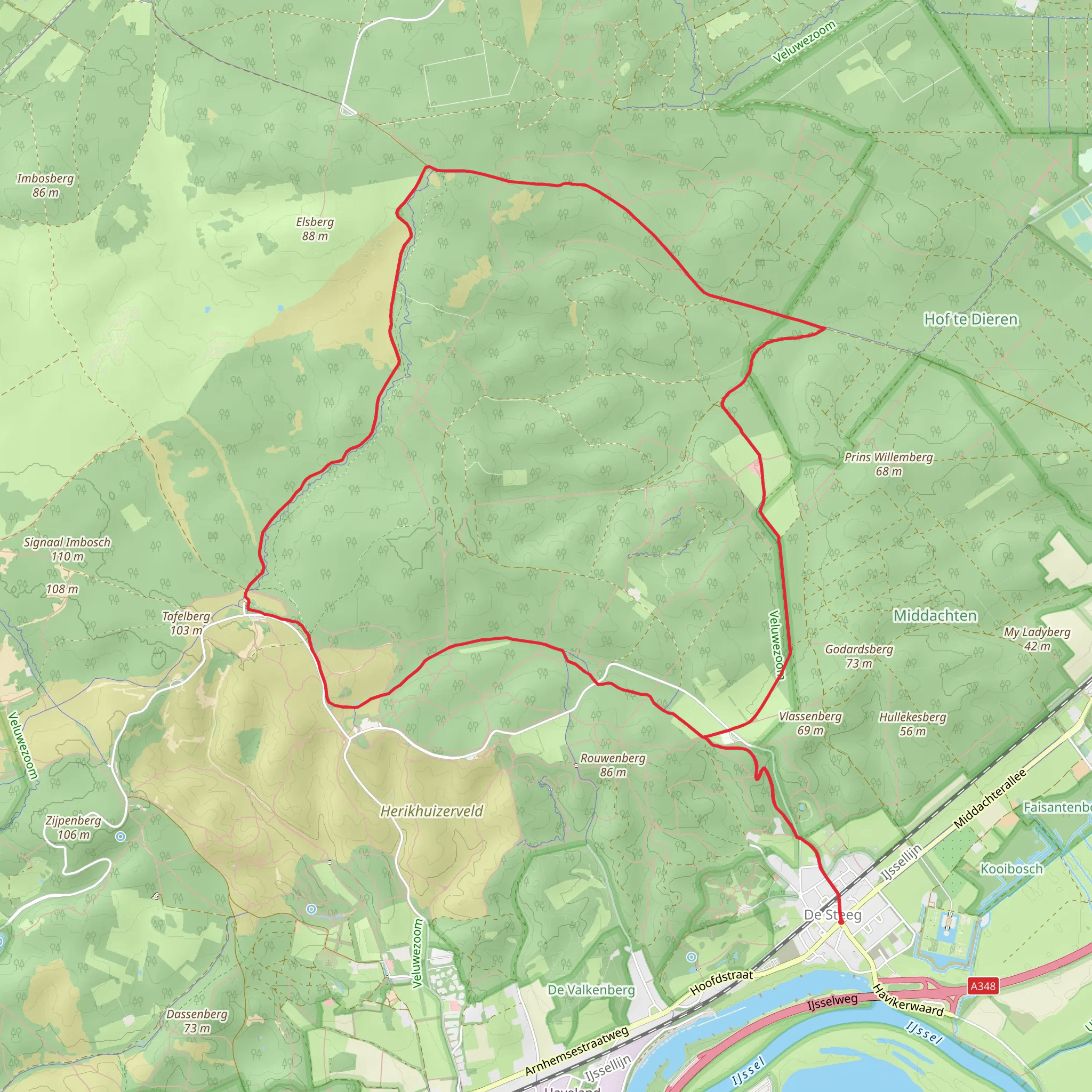
14.6 km
~3 hrs 2 min
74 m
Loop
“Wander gently between Groote Emmer, Bremberen and Lappendeken, where hedgerows, woods and wide skies keep shifting.”
This easy loop is a relaxed countryside walk of about 15 km (9.3 miles) with roughly 100 m (330 ft) of total ascent, linking a patchwork of small woods, hedgerows, and open fields around the hamlets of Groote Emmer, Bremberen, and Lappendeken. Expect mostly flat, gently rolling terrain with frequent changes in scenery rather than sustained climbs—ideal for a half-day outing at a steady pace.
Getting to the start (car + public transport)
Because the start point is listed only as “near” (no coordinates or town/road given), the most reliable way to plan arrival is to anchor your start at a recognizable local hub close to the three named places—typically a village church, community hall, or a signed trail parking area in or near Groote Emmer.
- By car: In this region, starts are commonly set near a village center where roadside parking is available (often near a church square or small café). Use HiiKER to open the route and identify the exact trailhead pin, then navigate to the nearest marked public parking area or village center adjacent to the pin.
- By public transport: Rural loops like this are usually reached via a regional rail station to a nearby town, then a local bus toward the hamlets. Again, the exact best stop depends on the precise trailhead location—check the trailhead pin in HiiKER, then choose the closest bus stop and plan the final 0.5–2 km (0.3–1.2 miles) walk-in.
If you share the trailhead coordinates (lon/lat) or a HiiKER link, I can convert them to the nearest known address/landmark and give a precise “get off here / park here” plan.
You’ll typically begin on quiet lanes or farm tracks, easing into the loop with minimal elevation change. Early on, look for the subtle “edge habitat” where fields meet hedges and small woodland strips—these are often the most wildlife-rich parts of a lowland walk. Underfoot, expect a mix of compacted dirt, grassy paths, and short paved connectors between hamlets. After rain, the lowest sections can hold water and become slick, especially where tractors have left ruts.
As you move between Groote Emmer and Bremberen, the route tends to alternate between: - Open agricultural views (big skies, long sightlines, wind exposure) - Sheltered green corridors (hedgerows, drainage ditches, small copses) - Hamlet-to-hamlet connectors (quiet roads with occasional local traffic)
The modest ascent—about 100 m (330 ft) total—usually comes in small increments: gentle rises onto slightly higher field margins, then back down into shallow dips where water collects.
Landmarks, landscape character, and what to watch for
The names you’ve provided strongly suggest a landscape shaped by long-term rural land use—fields divided and managed over generations, with small named places reflecting local history and dialect. In many parts of northwestern Europe, these hamlets and field names often trace back to medieval settlement patterns, with later agricultural intensification smoothing the terrain into today’s broad, workable parcels.
Along the loop, the most “significant” landmarks are often understated: - Hamlet centers: a small chapel/church, a cluster of older farm buildings, or a crossroads with a wayside feature. - Field boundary lines: old hedges and tree rows that can be remnants of historic property divisions. - Drainage features: ditches, culverts, and small bridges—evidence of how the land has been managed to keep fields productive.
What to look out for: - Farm operations: You may encounter tractors, livestock trailers, or temporary electric fencing. Give wide berth and keep gates as you find them. - Surface changes: A firm track can abruptly turn grassy or muddy at field edges; waterproof footwear is helpful in wet seasons. - Wind exposure: Open sections can feel cooler than expected; pack a light shell even on mild days.
Nature and wildlife
This is the kind of route where wildlife sightings depend on quiet movement and time of day rather than remote wilderness. Typical highlights in mixed farmland/wood-edge terrain include: - Birdlife: hedgerow songbirds, corvids, pigeons/doves, and raptors scanning fields. Early morning and late afternoon are best. - Small mammals: rabbits/hares along field margins; fox sign is common even if the animal isn’t seen. - Amphibians/invertebrates: near ditches and wetter hollows, especially in spring and after rain. - Seasonal color: spring blossoms in hedges, summer field-edge wildflowers, and autumn leaf change in the small wooded pockets.
Ticks can be present anywhere with tall grass and deer/fox activity—do a quick clothing check after grassy stretches.
Navigation and timing
Even on an easy loop, the most common “wrong turns” happen at: - Similar-looking farm junctions - Unmarked field-edge bends - Places where a track continues straight but the route turns onto a narrower path
Keep HiiKER open and confirm turns at every major junction. For timing, many hikers will take 3.5–5 hours for 15 km (9.3 miles) depending on pace, stops, and ground conditions.
What to pack for an easy 15 km (9.3 mile) lowland loop
- Footwear: trail shoes in dry conditions; light boots if it’s been wet (mud and ruts are the main issue).
- Water: at least 1–1.5 L (more in
Surfaces
Concrete
Asphalt
Unknown
Ground
Paved
Comments and Reviews
User comments, reviews and discussions about the Groote Emmer, Bremberen and Lappendeken Loop, Netherlands.
average rating out of 5
0 rating(s)