
Download
3D Flyover
Add to list
More
53.0 km
3 days
0 m
Multi Day
“A breezy, ruler-flat Brabant loop where long lanes, dikes, and farm edges reward patient pacing.”
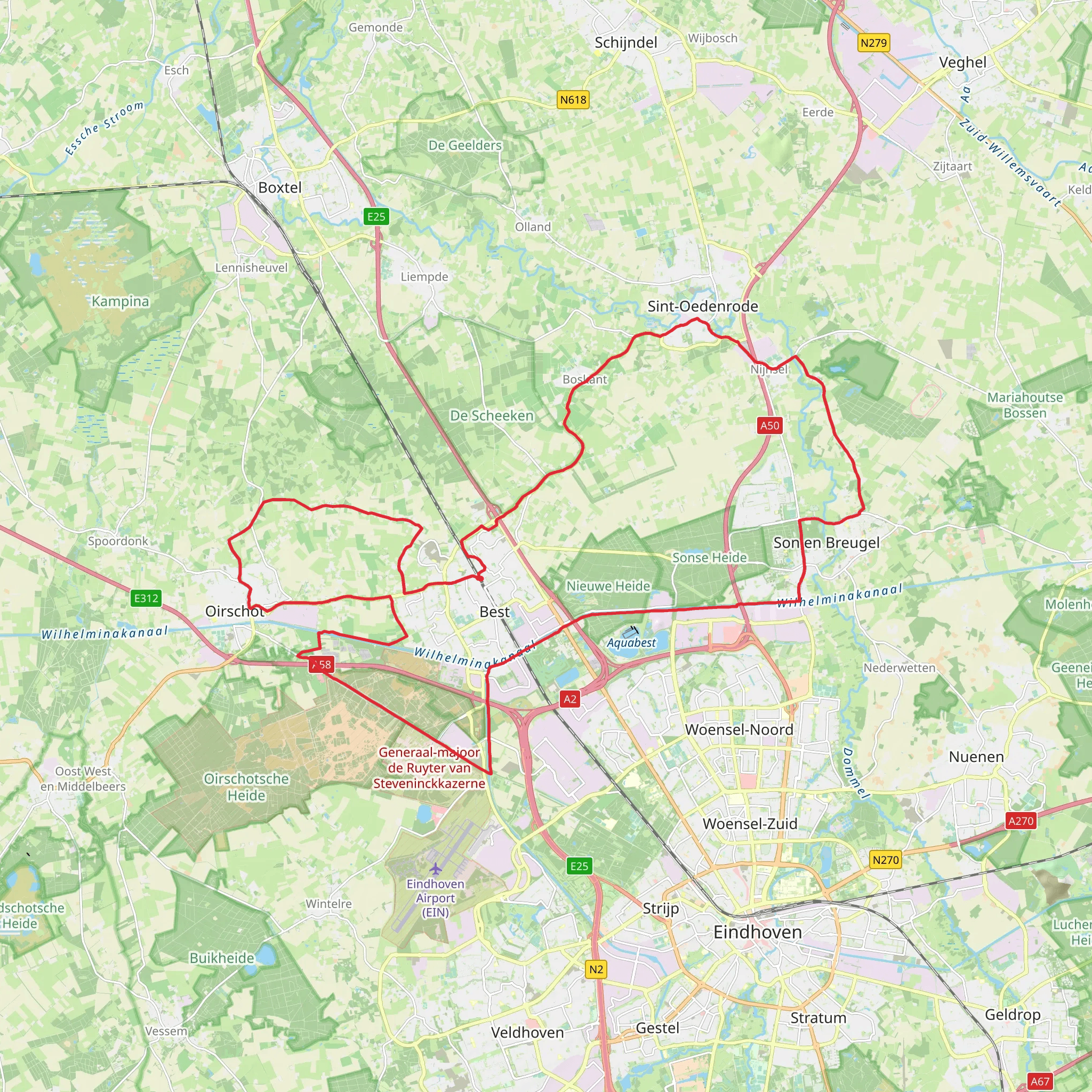
This is a long, low-relief loop of roughly 53 km (33 mi) with essentially 0 m (0 ft) of climbing—ideal for steady pacing, efficient footwork, and logistics-focused planning rather than elevation management. Expect a full-day outing for most hikers (often 9–13 hours depending on breaks and surface), with the main challenges being distance, repetitive hard surfaces, wind exposure across open fields, and staying oriented through a patchwork of farm lanes, dikes, and village edges.
Because your start point is listed only as “near” (no coordinates provided), I can’t reliably convert a lon/lat to a nearby address or landmark yet. If you share the start coordinates (or a HiiKER link), I’ll pin it to the nearest recognizable place (e.g., a station, church, trailhead parking area, or named junction) and tailor the access directions precisely.
Getting to the start (general, works well for this region)
This loop name strongly suggests the route threads through the Best / Oirschot / Eindhoven rural fringe in North Brabant (Noord‑Brabant), Netherlands, where “-dijk” segments commonly follow raised embankments and “grintweg” indicates older gravel roads.
By public transport (typical approach) - Aim for a rail hub such as Eindhoven Centraal or Best station (both are common gateways to the surrounding countryside). - From there, local buses and short walks can usually get you to the first farm lanes/dike paths. In this area, it’s common to start from a village center (near a church square) or a station and immediately connect to quiet agricultural roads.
By car (typical approach) - Look for parking near a village center, sports complex, or recreation area on the outskirts rather than trying to park on narrow farm lanes. - If the loop passes close to a canal/dike corridor, there are often small pull-offs near bridges—use only clearly designated parking to avoid blocking agricultural access.
If you provide the start point, I’ll recommend a specific parking spot and the most straightforward transit-to-trail connection.
What the terrain feels like over 53 km / 33 mi
With negligible elevation gain, the “difficulty” comes from surface and repetition: - Farm tracks & gravel lanes (grintweg): Usually fast and forgiving, but can be loose in places; after rain, some sections can be muddy or rutted by tractors. - Paved cycle paths & quiet roads: Efficient for distance, but harder on feet and joints over 50+ km. Cushioning and sock choice matter more than you’d expect on a “flat” hike. - Dike tops and embankments (dijk): Often straight, exposed, and breezy. Even mild wind can add fatigue over hours.
Plan your day around time-on-feet rather than elevation: many hikers do best with a run/walk-style break schedule (short, frequent stops) to keep feet in good condition.
Navigation and wayfinding (flat country can still be tricky)
Even without hills, this landscape can be deceptively complex: parallel farm lanes, drainage ditches, and frequent junctions can make it easy to drift off-route. - Load the route in HiiKER and keep it handy for junction confirmation—especially where a track bends around a farmyard or where a dike path meets a bridge. - Watch for private property cues: “no entry” farm signs, gates, and yard boundaries. In this region, the correct line often skirts farms via a signed public path or a field-edge track rather than cutting through a yard.
Landmarks, landscape character, and what you’ll see
This part of North Brabant is shaped by agriculture, water management, and historic road networks: - Old gravel roads (“Oude Grintweg”) often follow long-established lines between hamlets and fields—routes that predate modern paving and reflect how people and goods moved locally. - Dikes and drainage corridors (“Eindhovensedijk”) speak to the Netherlands’ long history of water control—raised embankments, managed waterways, and carefully parceled fields. Even when you’re not beside a major river, the landscape is engineered to move and store water. - Expect a rhythm of open fields, tree-lined lanes, small woodlots, and village edges. You’ll likely pass clusters of farm buildings, roadside chapels or small memorials, and occasional canal/stream crossings.
Historical significance here is less about dramatic ruins and more about cultural landscape: centuries of land reclamation, drainage, and farming have produced the straight lanes, ditches, and embankments that make long-distance walking possible on such flat ground.
Nature and wildlife to look out for
Wildlife sightings vary by season and time of day, but typical highlights in this kind of Brabant countryside include: - Birdlife: waterfowl and waders near ditches and canals; raptors (kestrels, buzzards) over fields; songbirds along hedgerows. - Mammals: rabbits and hares in field margins; roe deer are possible near quieter wooded patches, especially early/late. - Amphibians: near wetter ditches and ponds in spring.
Ticks can be present in grassy edges and low scrub—especially if you step off hard paths for breaks.
Food, water, and resupply strategy (critical for an “easy” 53 km)
A flat 53 km can still burn through supplies quickly. - Carry at least 1.5–2.5 L capacity and top up whenever you
AI Planner
Days planned around your pace, with somewhere to stay each night.
Surfaces
Asphalt
Unknown
Concrete
Gravel
Grass
Comments and Reviews
User comments, reviews and discussions about the Oude Grintweg, Bestseweg, Eindhovensedijk Loop, Netherlands.
average rating out of 5
0 rating(s)



